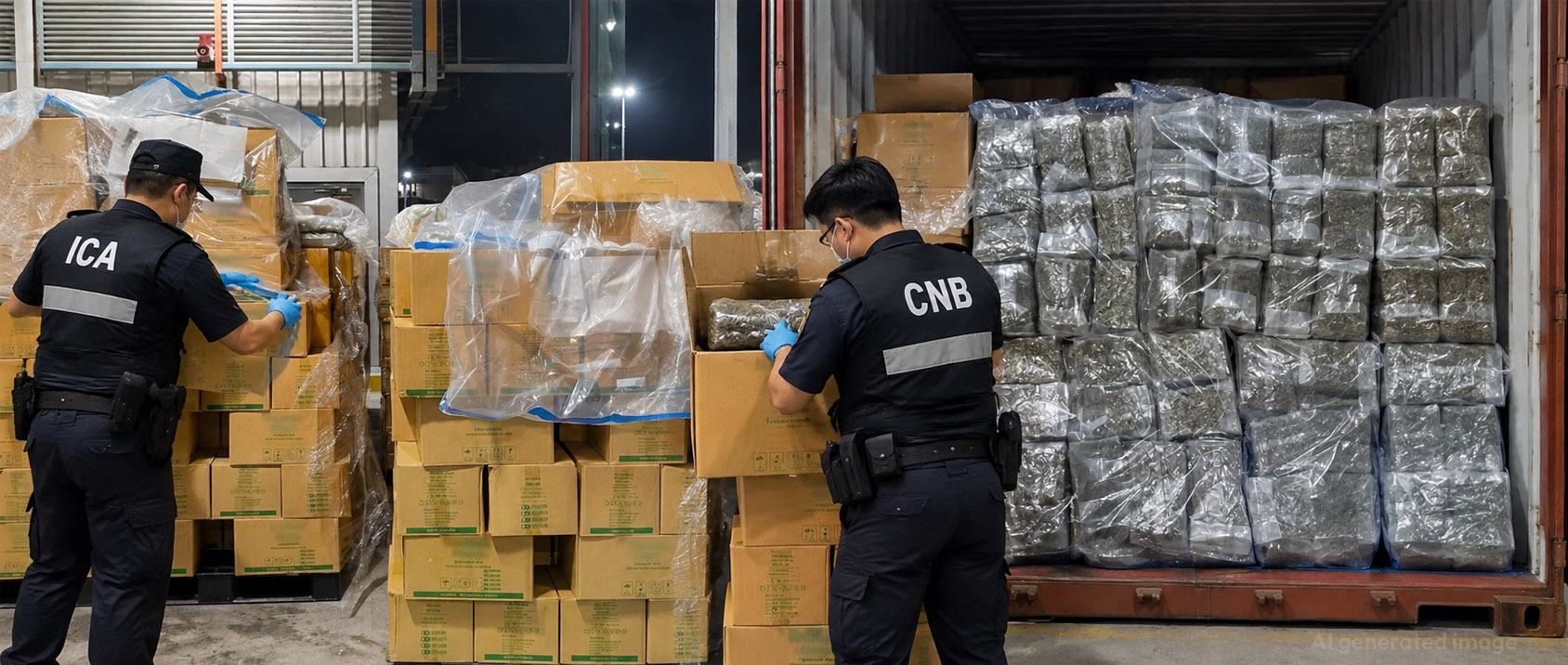
On 24 September 2026, Singapore authorities detected more than 391kg of cannabis concealed inside an inbound container at the Pasir Panjang Scanning Station. The discovery resulted from targeted screening by the Immigration & Checkpoints Authority (ICA), followed by further checks involving the Central Narcotics Bureau (CNB).
The case demonstrates how intelligence-led targeting, cargo scanning technology and cooperation between enforcement agencies continue to play an important role in protecting Singapore’s borders against drug trafficking and other forms of smuggling.
Enhanced Checks Identify Suspicious Container
The inbound container was identified through ICA’s targeting efforts and subsequently referred for enhanced inspection.
During the screening process, trained ICA Image Analysts identified anomalies in the container’s scanned images. Officers then conducted a physical inspection of the cargo and discovered blocks suspected to contain cannabis hidden inside boxes containing gloves.
CNB officers were immediately notified and carried out further checks on the container.
The subsequent examination uncovered a total of 1,290 blocks of cannabis weighing approximately 391kg.
Cannabis Concealed Within Boxes of Gloves
The concealment method used in this case highlights one of the challenges faced by border enforcement agencies when inspecting international cargo.
Illegal substances may be hidden within otherwise ordinary commercial shipments in attempts to avoid detection. Identifying such concealment therefore requires a combination of risk assessment, imaging technology and trained personnel capable of recognising irregularities in scanned cargo.
In this case, the anomalies identified by ICA’s Image Analysts resulted in a physical inspection and the eventual discovery of the concealed cannabis.
Drugs Were Transiting Through Singapore
Preliminary investigations indicated that the cannabis was transiting through Singapore and was intended for another country, rather than being destined for local distribution. Investigations into the shipment remain ongoing.
The case nevertheless demonstrates the importance of maintaining strong controls over transit cargo. Singapore’s position as a major international trading and logistics hub means its checkpoints must handle significant volumes of goods while simultaneously identifying shipments that may present security or trafficking risks.
Effective screening therefore helps prevent Singapore’s transport infrastructure from being exploited for international drug trafficking.
Singapore’s Misuse of Drugs Act and Cannabis Trafficking
Singapore maintains strict legislation governing the importation, exportation and trafficking of controlled drugs.
CNB and ICA stated that under Section 7 of the Misuse of Drugs Act 1973, persons who import into or export from Singapore more than 500g of cannabis may face the mandatory death penalty. Central Narcotics Bureau (CNB)
The legislation forms part of Singapore’s broader approach to deterring drug trafficking and preventing controlled substances from entering or passing through the country.
Technology Strengthens Singapore’s Border Security
The Pasir Panjang detection also highlights the increasingly important role of technology in modern border enforcement.
Cargo scanning systems enable officers to examine the contents of containers without relying solely on physical searches. When combined with targeting strategies and trained image analysts, these systems can help authorities identify unusual cargo patterns or possible concealment methods requiring further investigation.
ICA has stated that it will continue conducting security checks at Singapore’s checkpoints and working closely with CNB to prevent attempts to smuggle drugs across the country’s borders. These security efforts also extend to weapons, explosives and other forms of contraband.
Source: Adapted and independently rewritten from the joint news release issued by Singapore’s Immigration & Checkpoints Authority and Central Narcotics Bureau on 2 October 2026.